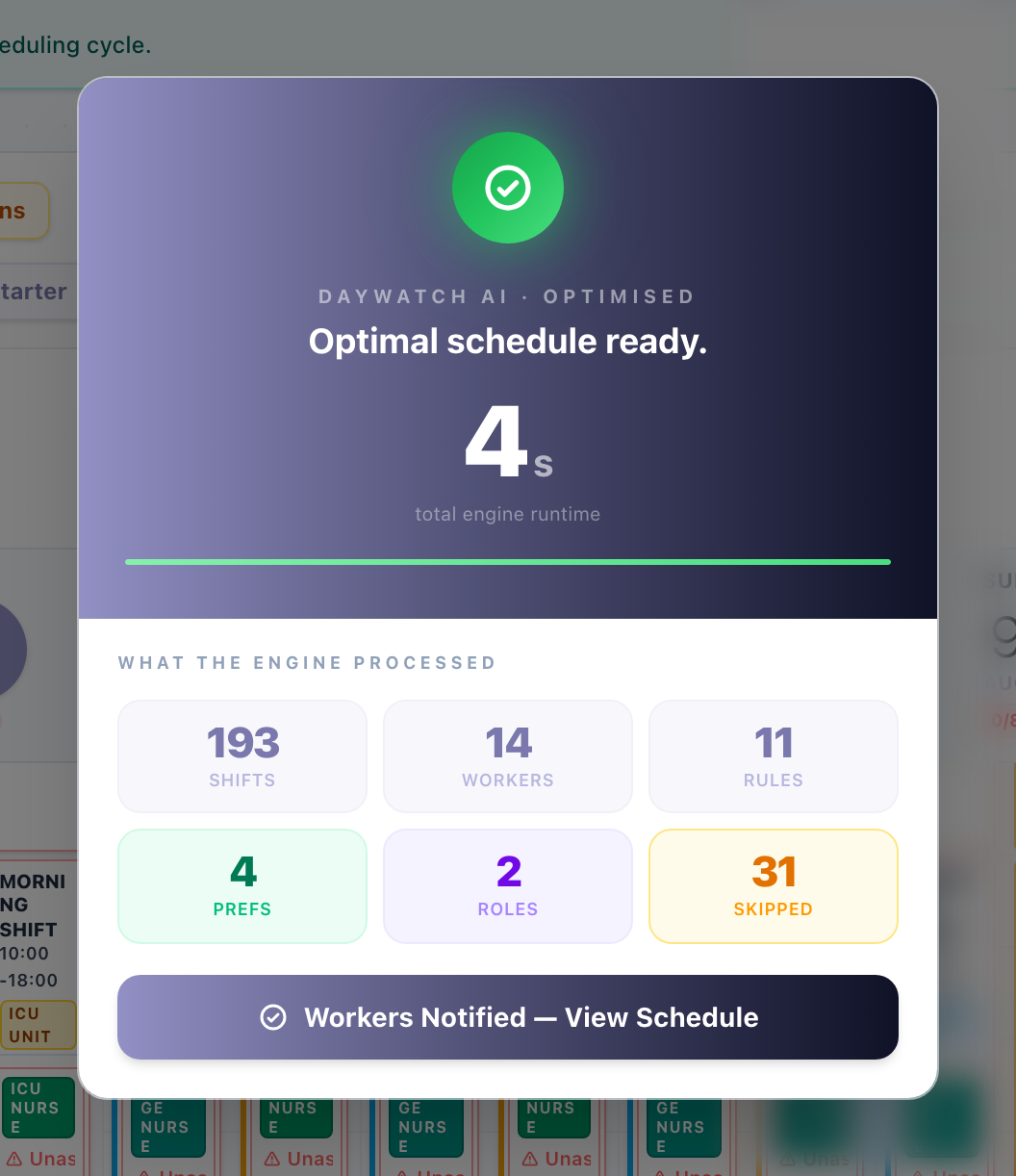
Auto-Schedule Now Completes in Seconds
A full roster, scheduled in seconds. For most teams, Auto-Schedule now finishes in well under 10 seconds — from button click to a complete, balanced, law-compliant schedule.
Scheduling a team of 10, 15, or 20 workers across multiple weeks is a genuinely complex computational challenge — thousands of possible combinations, dozens of rules, personal preferences, and contract caps, all needing to fit into a single optimal roster. Daywatch has made a major leap in how the scheduling engine runs, and the result now arrives in seconds.
What Changed
Auto-Schedule now typically completes in under 10 seconds.
The scheduling engine has been fundamentally re-optimized: it now resolves every worker–shift combination in a single, unified pass. All constraints — availability windows, hard rules, soft preferences, role requirements, contract caps, and shift load balance — are evaluated together, simultaneously, rather than in separate phases.
The result: a fully optimized schedule, in seconds.
Live progress tracking
While the engine runs, you can follow along — status messages move through each scheduling phase and finish quickly. The completion summary appears the moment scheduling is done, showing how many shifts were filled, how many workers received assignments, and how many seconds it took.
How This Helps Your Team
- Results in seconds. Click Auto-Schedule and the scheduling summary appears almost immediately.
- Faster iteration. Want to try a different rule configuration? Re-run Auto-Schedule and see the new results right away.
- Workers get notified faster. WhatsApp and email assignment notifications reach your workers almost as soon as the engine finishes.
- Less time in the interface, more time managing. A complete, optimized roster in a single click — no waiting required.
Try It Now
Open your manager dashboard and click Auto-Schedule in the top toolbar. For most teams, the completion summary will appear within seconds.