
For operations managers, labor compliance is a constant source of stress.
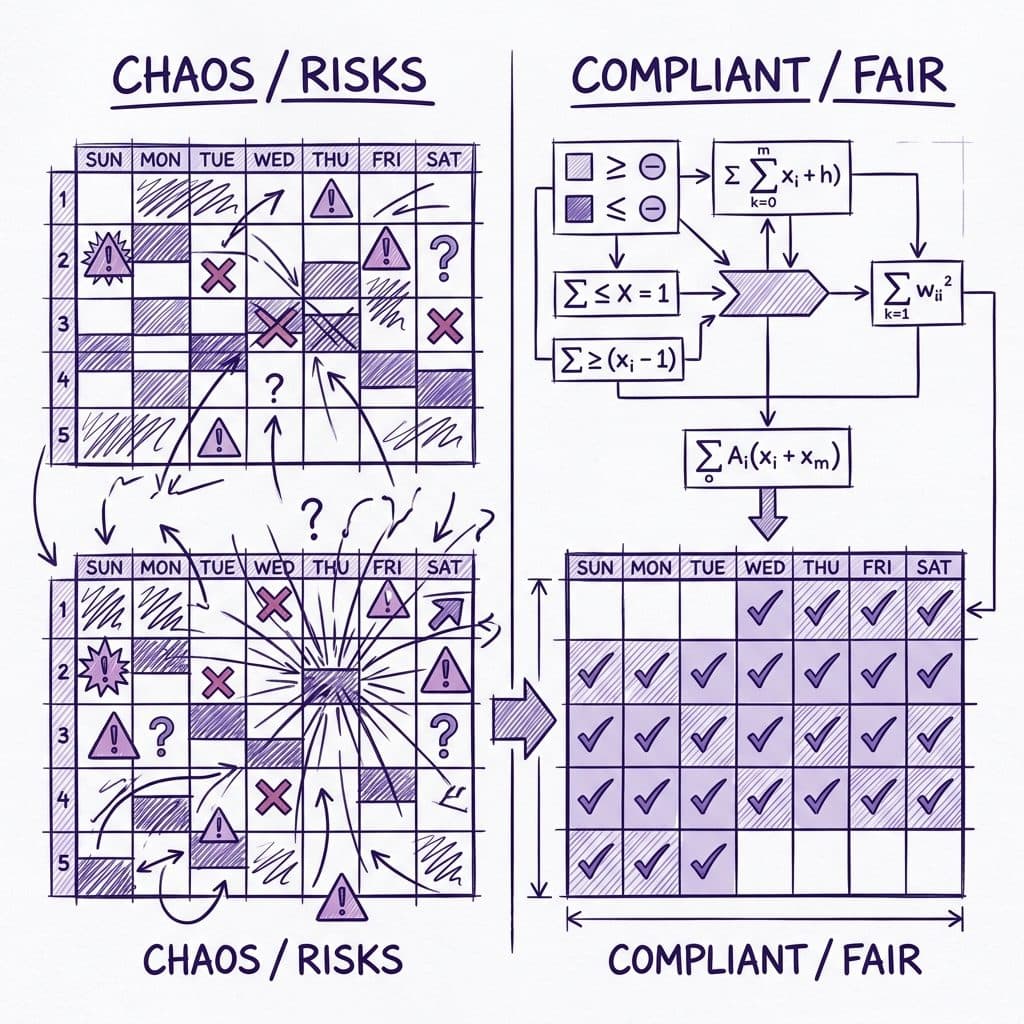
Between federal regulations, regional laws, and specific trade agreements, scheduling is a minefield of potential violations. The traditional approach is post-validation—building a schedule first and then checking it for errors. This is highly inefficient and leads to endless cycles of adjustments.
At Daywatch, we took a different path. We built our system around preventative compliance, using mathematical constraint satisfaction programming. Instead of checking for violations after a schedule is built, our engine ensures that a schedule cannot violate labor laws by design.
Here is a look inside the engineering that makes Daywatch the leading automated shift scheduling software with labor law enforcement.
You shouldn't audit your schedules for compliance. Compliance should be an unalterable bound of the schedule generation process.
1. Modeling Laws as Hard Constraints
In constraint programming, we divide scheduling rules into two distinct categories: Hard Constraints and Soft Constraints.
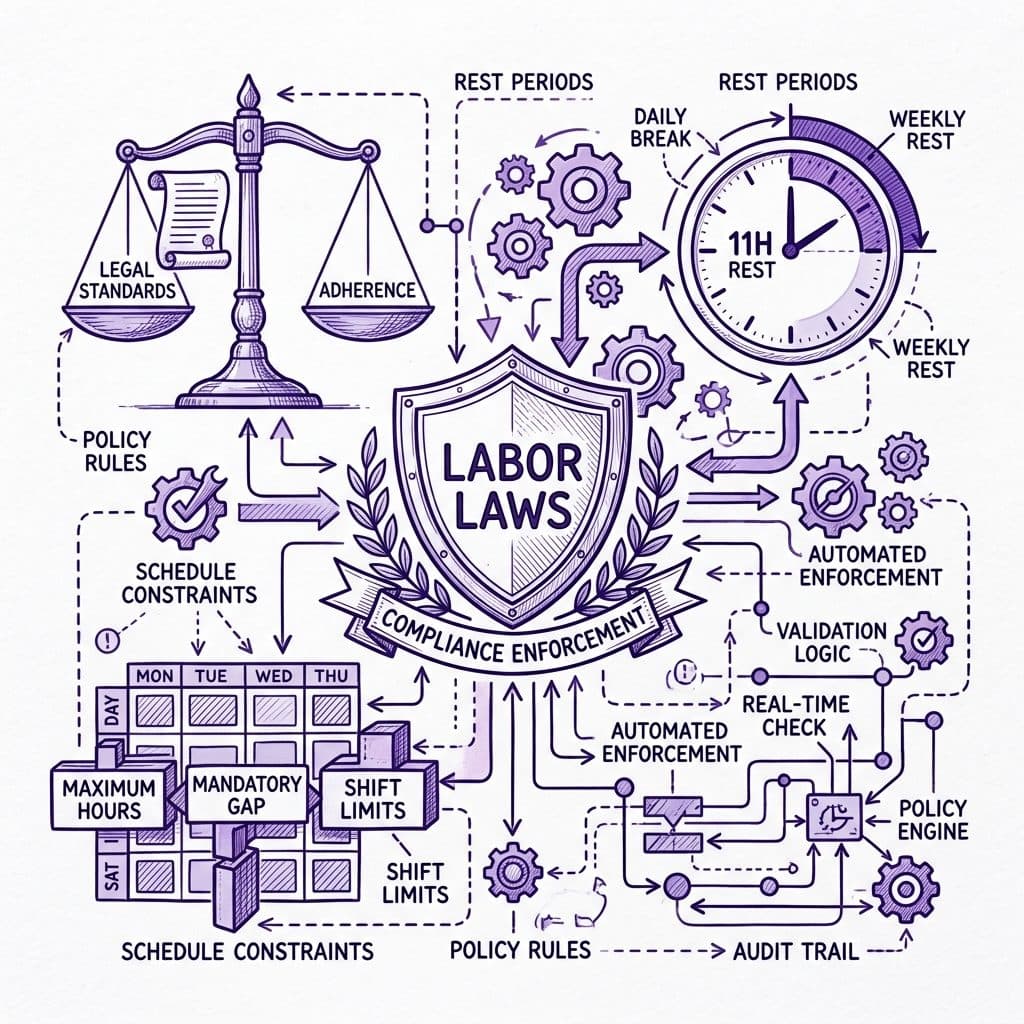
Hard constraints are non-negotiable boundaries. If a single hard constraint is violated, the schedule is invalid. We map national and regional labor laws directly into these hard constraints:
- Daily Rest Intervals: Modeling a strict requirement that a worker must have at least 11 hours of continuous rest between consecutive shifts.
- Weekly Limits: Enforcing a cap on maximum working hours in a rolling 7-day period (e.g., maximum 48 hours).
- Mandatory Rest Days: Ensuring a worker receives a continuous 36-hour rest period every week.
When the solver runs, it treats these constraints as absolute boundaries, pruning the search tree of any schedule combination that violates these rules before they are even suggested.
2. Natural Language to Programmatic Constraints
One of the largest hurdles in implementing automated compliance is the translation of legal texts into code. Traditional platforms require custom engineering to edit rules.
Daywatch resolves this using a Natural Language Logic (NLL) compiler. A manager can describe a labor policy or union agreement in plain text:
“Workers on night shifts must have at least 14 hours of rest before their next shift, and cannot work more than 3 consecutive nights.”
Our local LLM parsing layer translates this plain text rule into a set of mathematical variables and bounds that are instantly fed into the constraint solver. This bridges the gap between operational policy and mathematical enforcement with zero code.
3. Real-Time Interactive Validation
Compliance is not just about the weekly generation cycle. It is also about the daily changes—swaps, callouts, and manual overrides:
- Manual Overrides: If a manager attempts to drag-and-drop a worker into a shift that violates a labor law, the system intercepts the action.
- Contextual Warnings: Rather than a generic error, the UI displays exactly which rule is being broken (e.g., "Violation: Less than 11 hours rest since yesterday's night shift").
- Eligible Backups: When a worker calls in sick, the replacement dropdown only suggests workers who can take the shift without triggering a compliance violation.
This dual-layer protection—automated layout generation + real-time replacement validation—is why Daywatch stands out as the premier automated shift scheduling software with labor law enforcement.
Moving Beyond Risk Management
Automating labor law compliance does more than protect your organization from fines; it establishes a culture of trust and care. When employees know their rest periods are mathematically protected, burnout drops, retention rises, and your scheduling operations become a competitive advantage.
Discover how Daywatch enforces labor rules natively by scheduling a personal demo or signing up for a trial.