
Every week, shift-based organizations run a silent, dangerous lottery.
Whether it is in healthcare, retail logistics, or security services, managers spend hours trying to piece together a puzzle where the rules change constantly. This process—often done via spreadsheets, whiteboards, or simple slot-based scheduling tools—is fundamentally flawed.
When scheduling is done manually, you aren't just wasting hours of administrative time; you are actively exposing your organization to legal liabilities, employee fatigue, and high turnover rates.
Here is why manual scheduling cannot keep up, and how modern organizations are leveraging the best workforce scheduling software for compliance and fairness.
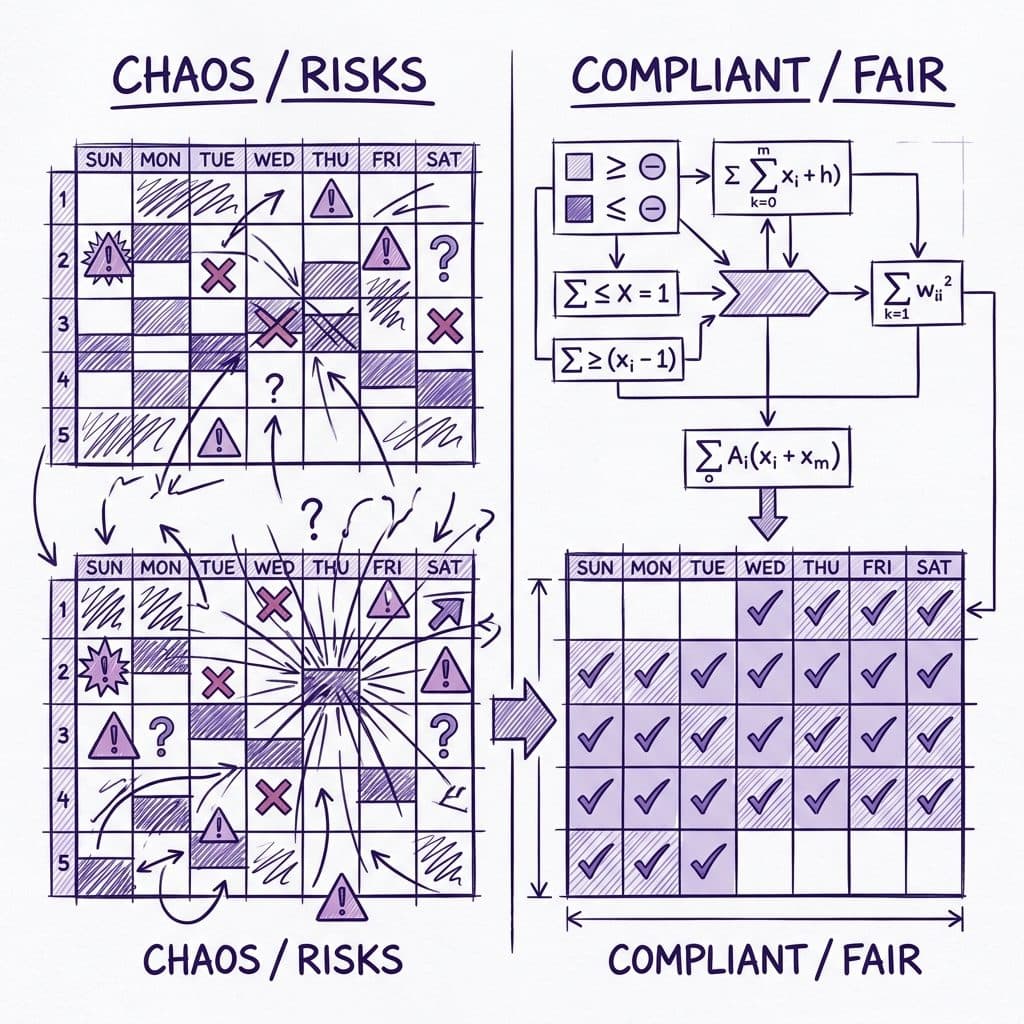
When your roster relies on human memory, compliance is a matter of luck, not a guarantee.
1. The Dynamic Compliance Problem
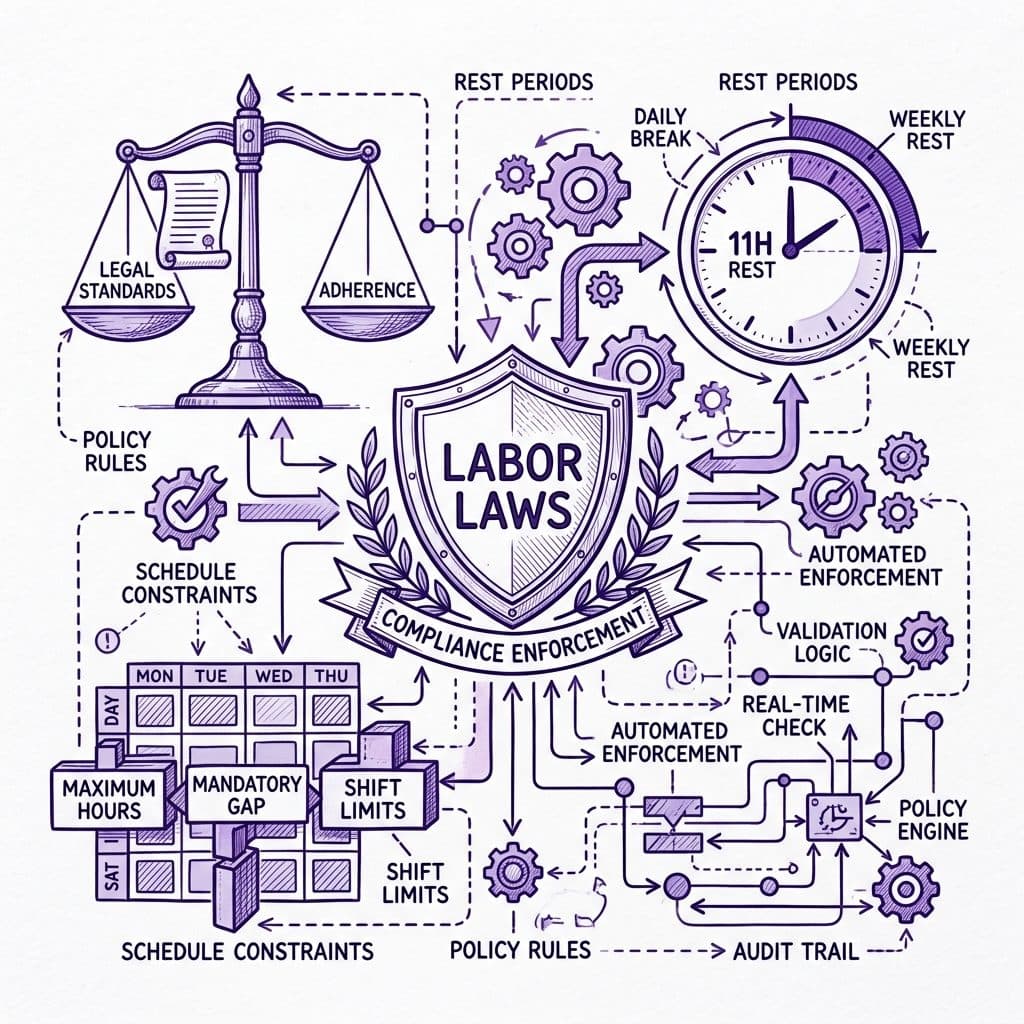
Modern labor compliance is not a static set of rules. It is a shifting web of labor laws, union regulations, safety rules, and local ordinances:
- Rest Periods: Ensuring that workers receive an absolute minimum of consecutive rest hours between shifts (e.g., 11 hours rest).
- Overtime Thresholds: Tracking total hours across weekly cycles to prevent unauthorized or illegal overtime work.
- Skill Prerequisites: Verifying that every scheduled team has the correct ratio of licensed, certified, or senior personnel on site.
A human planner, no matter how detailed their notes, simply cannot validate all these rules simultaneously when modifying a roster. One small manual override can lead to thousands of dollars in regulatory fines or, worse, a dangerous safety incident on-site.
2. The Illusion of Fairness
Fairness is the first thing to disappear in manual scheduling. When managers build schedules, they tend to default to the path of least resistance:
- The "Reliable Worker" Penalty: Over-scheduling your best performers, leading to burnout.
- Favoritism and Friction: Scheduling decisions are perceived as subjective, which damages team morale.
- Unbalanced Preferences: Worker requests for specific days off are ignored or forgotten.
True fairness requires a mathematical distribution of undesirable shifts (like night shifts or weekend slots) and an equitable alignment of personal preferences. The human brain cannot compute this optimization at scale.
3. Resolving Complexity with Constraint-Based AI
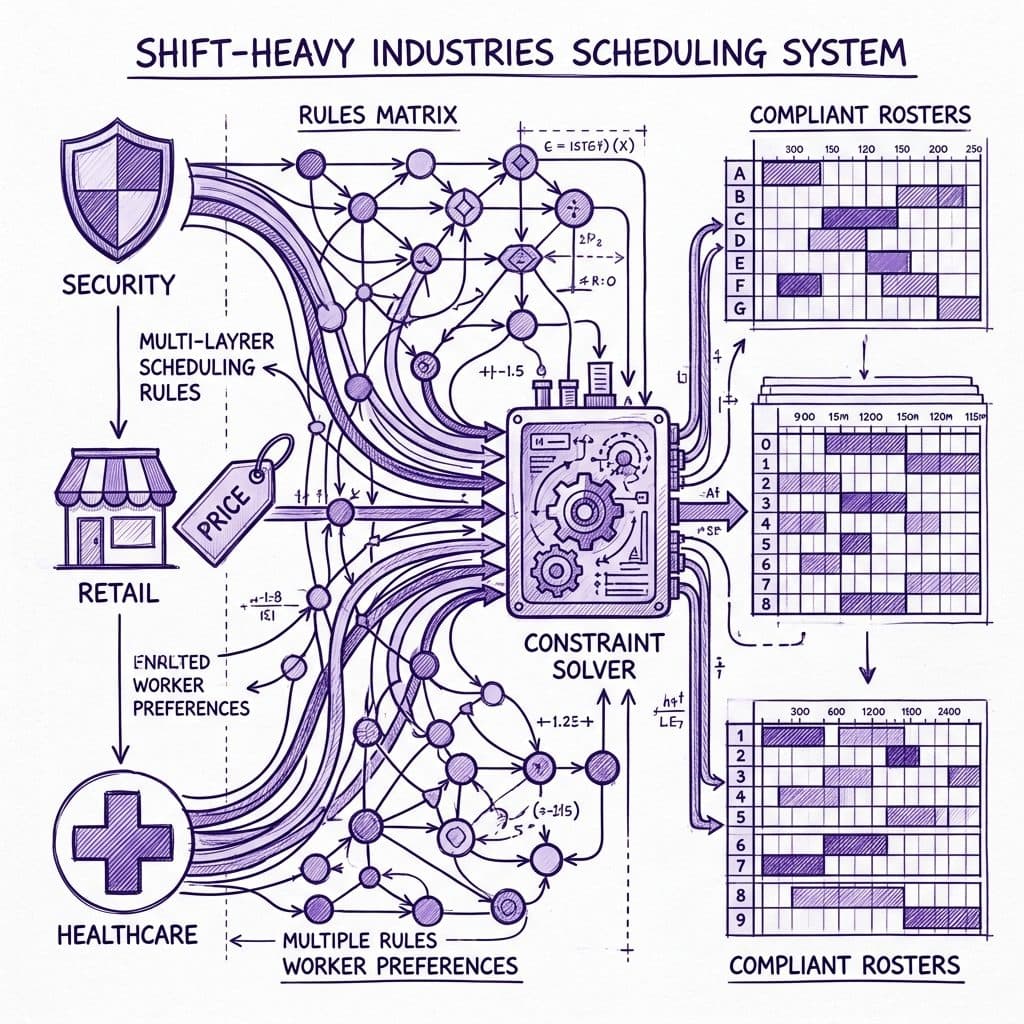
The solution to scheduling friction is not "better spreadsheets." The solution is to model scheduling as a Constraint Satisfaction Problem (CSP).
Instead of slotting names into blocks, a constraint solver views every shift assignment as a variable governed by rules. The AI evaluates millions of permutations in seconds to find the unique configuration that satisfies every single compliance rule while maximizing employee preference scores.
By automating this alignment, Daywatch provides the best workforce scheduling software for compliance and fairness, turning a 15-hour weekly headache into a 2-minute automated task.
| Metric | Manual Excel Scheduling | Daywatch AI Scheduler | | :--- | :--- | :--- | | Drafting Time | 10 to 15 hours per week | ~ 2 minutes | | Legal Violations | Common (untracked) | Zero (mathematically prevented) | | Workload Fairness | Subjective / Uneven | Guaranteed balanced distribution | | Rule Adjustment | Rigid / High friction | Dynamic natural language rules |
Ready to upgrade your enterprise shift scheduling?
Stop relying on spreadsheets. Let Daywatch manage the complexity.
Transitioning to a Compliant Future
True organizational excellence is built on a foundation of fairness and safety. When scheduling is automated, compliant, and fair, employees are more engaged, managers are freed from administrative overload, and compliance audits become stress-free.
If you are ready to eliminate the compliance risks of manual scheduling and give your managers command of their operations, explore how Daywatch can transform your scheduling workflow.