
When managing a shift-based workforce, it is easy to assume that employee scheduling is simple: you have a list of people, a list of shifts, and you just match them until all slots are filled.
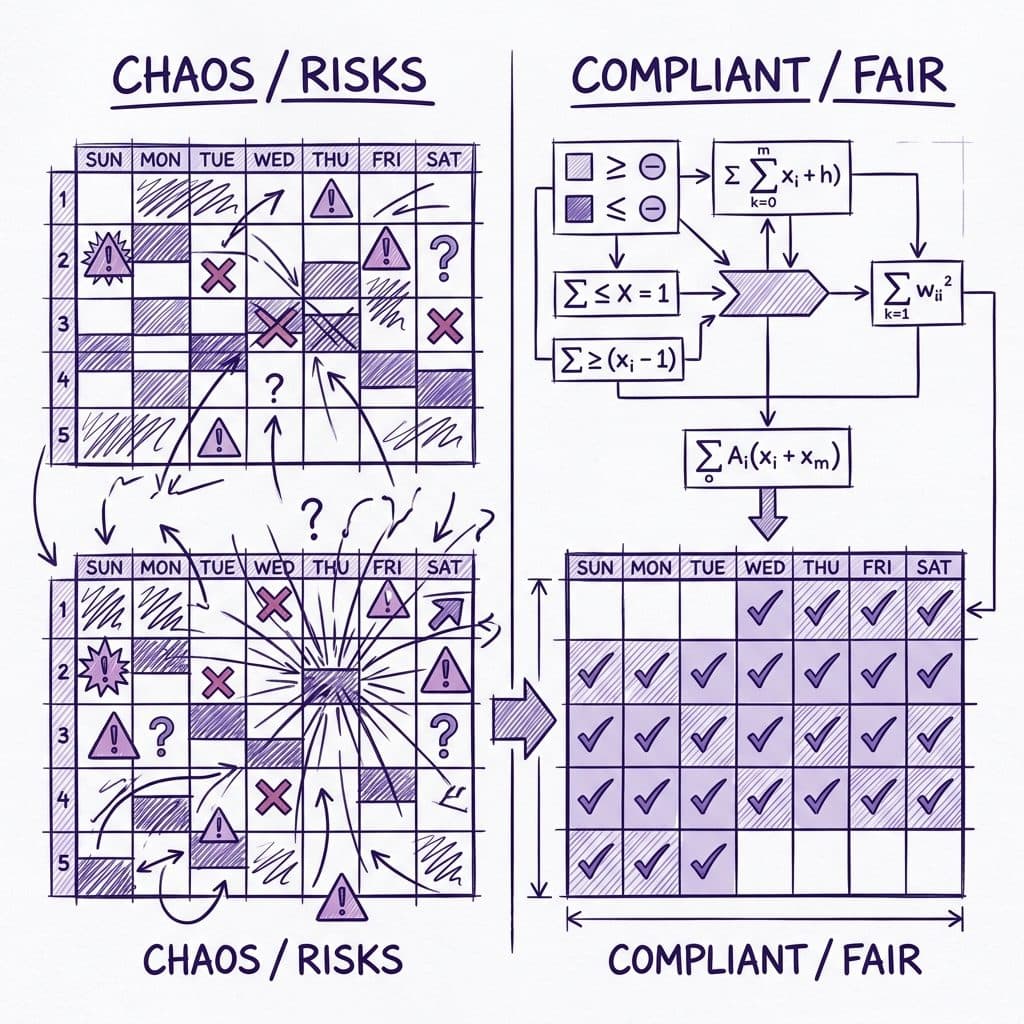
In reality, scheduling is one of the most notoriously difficult problems in computer science and mathematics. In academic research, it is studied under the name of the Nurse Scheduling Problem (NSP) or Nurse Rostering Problem (NRP)—and it has been proven to have NP-hard complexity. You can see how these rules and constraints are solved dynamically in practice using our interactive Nurse Roster Playground.
To understand why this is a challenge, we have to look at how quickly combinations grow, and how modern Artificial Intelligence (AI) and Constraint Programming (CP) make this unsolvable math puzzle solvable in real-time.
The Combinatorial Explosion: The Factorial Trap
The difficulty of staff scheduling stems from the math behind permutations. If you have 3 employees and 3 jobs, there are 3! (3 factorial) or 3 × 2 × 1 = 6 possible ways to assign them. This is easy to solve by hand.
However, if you scale this up to 4 employees and 4 jobs, the number of combinations rises to 4! = 24. For 10 employees, it becomes 10! (approximately 3.6 million). For 15 employees, the possible ways to allocate shifts jumps to over 1.3 trillion (15! = 1,307,674,368,000).
By the time you manage a workforce of 100+ employees with multiple overlapping shifts, the number of scheduling possibilities exceeds the number of atoms in the observable universe. If a computer were to evaluate every combination one-by-one to find the "best" schedule, it would take longer than the age of the universe. This phenomenon is known as the combinatorial explosion.
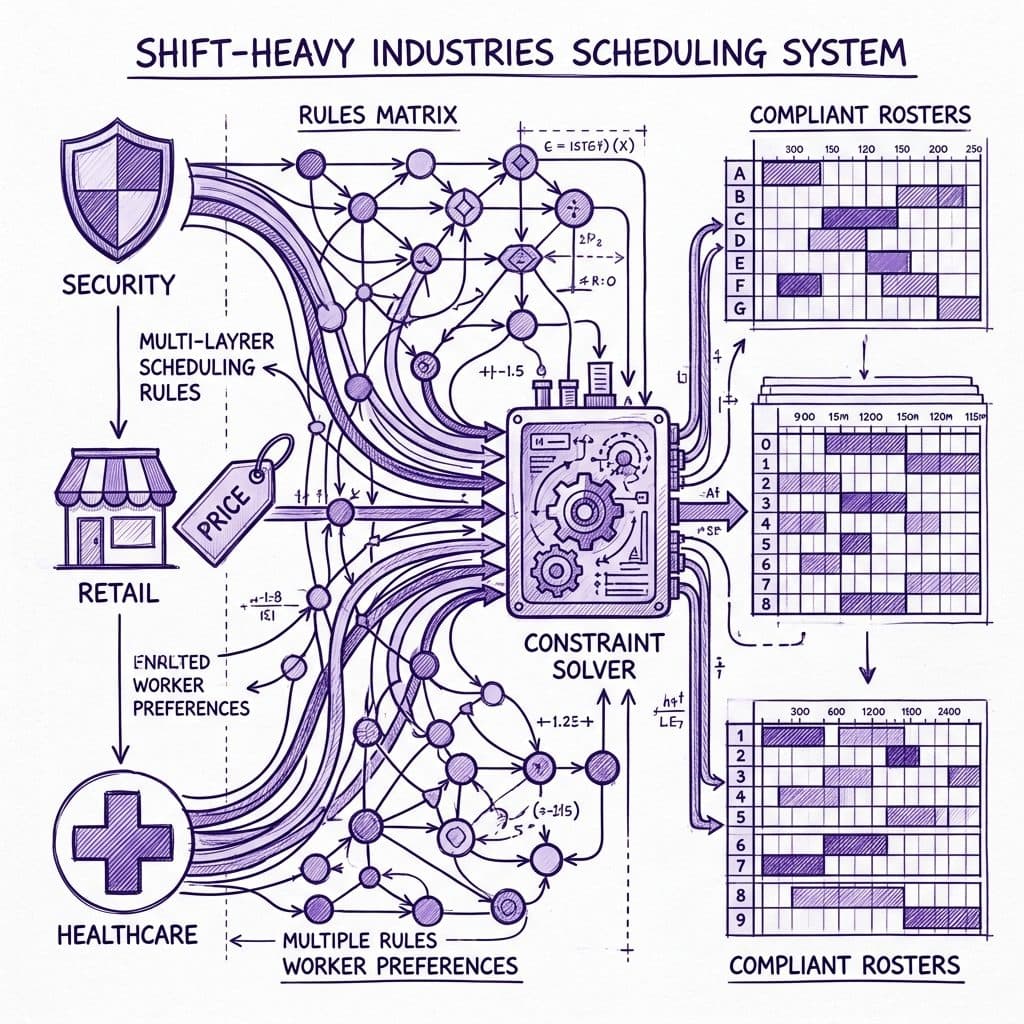
So, how do modern workforce platforms like Daywatch solve this without a supercomputer? The secret lies in a combination of Constraint Programming (CP) and AI Search Heuristics.
Step 1: Constraint Programming & Domain Reduction
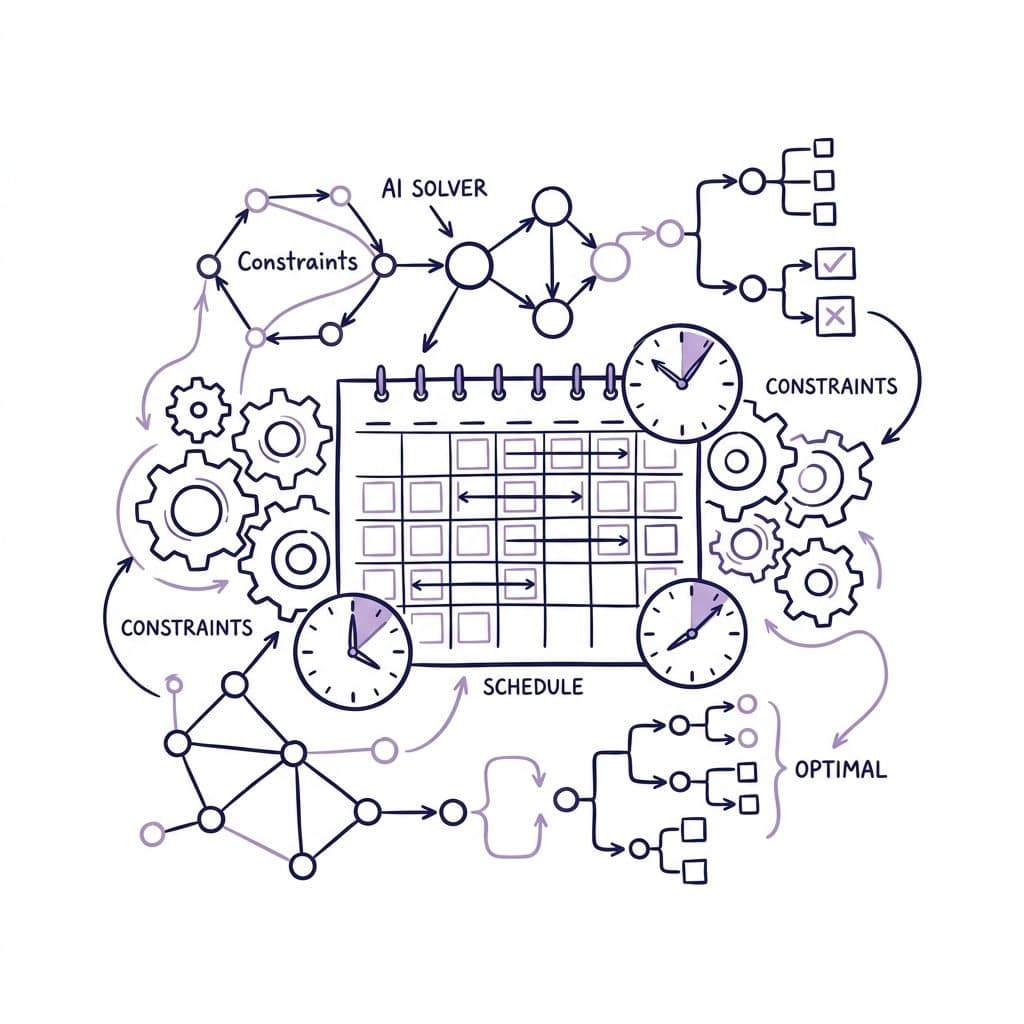
If we cannot search the entire universe of schedules, we need a way to prune the decision tree. This is where Constraint Programming comes in.
In scheduling, we define two types of rules:
- Hard Constraints: Legal or physical requirements that cannot be broken (e.g., a worker cannot be in two places at once, maximum legal work hours, or minimum rest breaks between shifts).
- Soft Constraints: Organizational preferences or employee desires (e.g., keeping weekends fair, avoiding consecutive night shifts, or honoring specific time-off requests).
Constraint Programming uses domain reduction and constraint propagation to narrow down the choices. When the algorithm starts building a schedule, it immediately applies the hard constraints. For example, if Worker A is assigned to a night shift, the constraint engine instantly rules out any schedules where Worker A is placed on the following morning's shift (often called a "clopening" violation).
By enforcing these strict legal and operational boundaries first, the solver dynamically prunes 99.9% of the invalid search space. Instead of testing trillions of combinations, the algorithm only evaluates the tiny subset of valid, legal schedules.
Step 2: AI Heuristics & Metaheuristic Local Search
Once hard constraints have cut the search space down, we are left with a smaller (but still very large) set of legal schedules. To find the highest-quality schedule based on soft constraints (like employee preferences), the algorithm uses Metaheuristic Local Search.
Rather than searching systematically, metaheuristic algorithms use strategies inspired by natural systems:
- Genetic Algorithms (GA): The solver generates an initial "population" of random valid schedules. It evaluates each schedule's quality based on a fitness function (e.g., how many employee preferences are satisfied). The best schedules are "bred" together (exchanging shift structures) and "mutated" (introducing small random swaps) to produce a new generation of even better schedules.
- Tabu Search: The solver starts with one valid schedule and makes incremental changes (like swapping two workers' shifts). It tracks these moves and puts recently tried changes on a "Tabu list" to prevent the algorithm from getting stuck in a loop.
By using these search heuristics, the AI traverses the decision landscape efficiently, climbing toward the optimal schedule in seconds instead of years.
Bringing Real-World Compliance Into the Equation
To feed these constraint engines correctly, developers need access to structured, up-to-date labor regulations. This is why our research team compiled the Global Shift Scheduling Compliance Dataset.
By converting complex legal text into structured parameters—such as predictive notice durations, daily/weekly overtime thresholds, and mandatory rest periods—the data can be directly converted into hard mathematical variables for the constraint solver.
Ready to upgrade your enterprise shift scheduling?
Stop relying on spreadsheets. Let Daywatch manage the complexity.
Reclaiming Operational Agility
When you understand the underlying operations research, you realize that scheduling is not just an administrative task—it is a complex optimization puzzle. Expecting managers to solve this in Excel is a recipe for compliance violations, employee burnout, and lost productivity.
Modern automated scheduling platforms like Daywatch handle this complexity by utilizing custom-built AI constraint engines. By letting the algorithm process the combinatorial math, managers are freed to focus on what matters most: leading their teams and growing the business.